
Why Your "Profitable" Business Still Feels Broke
Your P&L says you made money, but your bank account disagrees. Here's why that happens, and how Profit First flips the equation so profit stops being an afterthought.
Your accountant tells you the business turned a profit last year. Then you look at the bank balance, the credit card statement, and the payroll you have to cover on Friday, and none of it feels like profit.
If that sounds familiar, you're not bad at business. You're running on a formula that almost guarantees this feeling.
The formula most businesses run on
Traditional accounting teaches a simple equation:
Sales − Expenses = Profit
It's accurate. It's also backwards for how humans actually behave. When profit is whatever is left over, there's rarely anything left over. Expenses expand to fill the money available. A good month becomes new software, a new hire, or a "we'll catch up next month" mindset, and profit quietly disappears.
Flip the equation
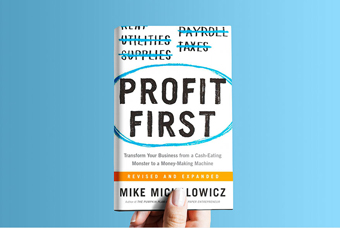
Profit First, the method popularized by Mike Michalowicz, makes one change:
Sales − Profit = Expenses
You take your profit first, the moment revenue comes in, and run the business on what remains. It's the same logic as paying yourself first in personal finance. When the money for expenses is deliberately limited, you get creative about spending it well.
How it works in practice
Profit First uses a small set of bank accounts, each with one job:
- Income – every dollar of revenue lands here first.
- Profit – a percentage set aside as a reward for the owner and a reserve for the business.
- Owner's Pay – what you pay yourself for the work you do in the business.
- Tax – money set aside so tax season stops being a crisis.
- Operating Expenses – what the business actually runs on.
On a regular rhythm (many businesses use the 10th and 25th of each month), you move money from Income into the other accounts by set percentages. Then you pay bills only from Operating Expenses.
Start where you are, not where you "should" be
The biggest mistake owners make is jumping straight to ideal percentages. If your business currently keeps 0% as profit, setting aside 15% next week will break something.
Instead:
- Figure out your current allocation percentages from your last 12 months of numbers.
- Compare them to target allocation percentages appropriate for your revenue size.
- Close the gap gradually, typically a point or two per quarter.
Small, steady moves stick. Big, sudden ones get abandoned.
What changes when you do this
Owners who implement Profit First usually notice three things fairly quickly:
- Clarity. A glance at your bank accounts tells you what's truly available to spend.
- Discipline without willpower. The system makes the hard decisions for you.
- A real reward. Profit becomes something you actually receive, not a number on a report.
Your next step
If you'd like to see where your business stands today, we can help. Book a free Consulting Call, send us your last 12 months of P&L, and we'll walk you through the top three changes to make in the next 90 days. Prefer to start on your own? Try our Profit First Instant Assessment.
Questions & Answers
Why does my business show a profit but I have no cash?
Profit on your P&L and cash in the bank are different measures. Profit can be tied up in unpaid invoices, inventory, debt payments, owner draws, or spending that isn't fully reflected yet. Without a system that sets cash aside on purpose, money that looks like profit on paper usually gets spent on operating costs before you ever see it.
What is the Profit First method?
Profit First is a cash management method, popularized by Mike Michalowicz, that flips the traditional formula from Sales − Expenses = Profit to Sales − Profit = Expenses. Each time revenue comes in, a set percentage moves into separate bank accounts for profit, owner's pay, and taxes first, and the business runs on what remains.
What bank accounts do I need for Profit First?
Profit First starts with five core accounts: Income, where all revenue lands; Profit; Owner's Pay; Tax; and Operating Expenses. On a regular schedule you transfer money from Income into the other four by set percentages, and pay business bills only from the Operating Expenses account.
How often should I do Profit First allocations?
Many businesses allocate twice a month, often on the 10th and 25th. A steady rhythm smooths out cash flow, makes it easy to see trends, and stops you from reacting to every individual deposit. The exact schedule matters less than doing it consistently.
How fast should I increase my profit percentage?
Gradually. Start from your current allocation percentages and raise profit by roughly a point or two each quarter rather than jumping to your target all at once. Small, steady increases give the business time to adjust its spending, which is why the habit tends to stick.